

Best Electronic Shooting Targets for Dry Fire Training in 2026 | VPDOT
VPDOT Bluetooth 4-Target Dry Fire System: Full Review and Training Guide 2026
Four wireless targets. One remote. Three training modes. Here is the complete breakdown of what this system does, who it is for and exactly how to train with it.
See it in action before you read the full breakdown.
Single target dry fire has a ceiling. You can sharpen your trigger pull, work your draw and build solid accuracy fundamentals with one panel on a wall. But the moment you need to train target transitions, the whole thing breaks down. You cannot simulate moving between targets with a single stationary sensor.
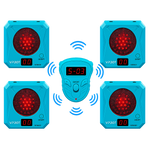
The VPDOT Bluetooth 4-Target System was built specifically for this gap. Four wireless laser targets that communicate with each other through a smart remote. Three training modes that force you to move, react and make decisions under time pressure. This is not a toy and it is not a casual add-on to your dry fire kit. It is a serious multi-target training system for shooters who want to get better at the parts of shooting that matter most in competition and real defensive situations.
Here is everything you need to know.
What Is in the Box
Everything you need comes in one package. No separate app purchase, no proprietary cartridge required, no subscription.
Four Bluetooth laser targets, one wireless smart remote with a 4-digit LED display, one USB-C charging cable, four difficulty reducer rings in four sizes (D40 / D27.7 / D16.8 / D8.5mm), four magnetic center covers and a bilingual user manual. Both the targets and the remote are USB-C rechargeable. No disposable batteries.
Full Specs
The 3 Training Modes Explained

Each mode trains a different skill. Most shooters start with Score Mode, progress to Timer Mode once they are comfortable with the system, then run Random Mode when they want to push reaction speed and multi-target awareness.
Score Mode (S-01)
Set your shot count using the remote. All four targets light up. Shoot them down to zero as fast as possible. The remote tracks your time and displays your score the moment you hit the last target. Raw speed under pressure. You know exactly what to do, the clock is running, and you need to execute.
Best for: shooters building split time speed and learning to work a multi-target layout efficiently.
Timer Mode (S-02)
One target lights up at a time. Hit it. The system pauses for 3 to 8 seconds then the next target activates in a random position. Your reaction time to each target is displayed on the remote after each hit. No pattern to memorize, no way to anticipate. Just you and your reaction speed.
Best for: reaction training, target acquisition drills and building the snap-to-target instinct competitive shooters develop over years of practice.
Random Mode (S-03)
Between one and four targets activate in random combinations. Hit all of them. The system resets to a new random combination. This mode most closely mirrors real-world multi-target scenarios where you have to identify, prioritize and engage targets in a sequence you did not plan for.
Best for: advanced shooters, competition prep and anyone building decision-making speed under pressure.
How to Mount the Targets
Four ways. Each target has a strong built-in magnet, a 1/4" tripod screw hole, a hanging hook and a flat base for tabletop placement. In practice most people use a combination: two on a metal cabinet with the magnets, one on a tripod for height variation and one on a shelf. That spread forces you to work different angles in a single drill.
The magnetic mount is strong enough to hold the target on a standard metal filing cabinet, refrigerator or gun safe door without sliding. No tools, no holes in the wall.
The 4 Difficulty Rings
Each target comes with four rings that physically shrink the sensor area. The largest is D40mm, wide enough for beginners to build confidence. The smallest is D8.5mm, a serious precision challenge that competitive shooters use to simulate tight zone shots under time pressure.
Start with the largest ring and run each training mode until you are consistently hitting the sensor. Drop to the next ring size and repeat. This is the same progressive overload principle that strength training uses, applied to shooting accuracy.
5 Drills to Run With This System
The Baseline
Score Mode, 10 shots per target, all four rings on D40mm. Record your total time. Run this at the start of every session to track improvement. Your baseline is your benchmark.
The Reaction Test
Timer Mode, 20 reps. Focus only on the time between target activation and your hit. Do not rush the draw. Work the fundamentals and let the speed come naturally. Track your average reaction time over 5 sessions.
The Transition Builder
Random Mode, D27.7mm rings. Focus on smooth target-to-target movement. No slapping the trigger, no rushing the transition. Controlled, deliberate movement between targets at speed. This drill directly transfers to USPSA stage performance.
The Precision Gauntlet
Score Mode, D8.5mm rings, 5 shots per target. This is hard. The smallest ring at competition speed exposes every flaw in your trigger pull and sight alignment. Run this when you want to identify exactly where your technique breaks down.
The Full Session
Run all three modes back to back. Score Mode to warm up. Timer Mode to sharpen reaction. Random Mode to finish under pressure. A complete 20-minute training session that covers every skill this system trains.
How It Compares to Single-Target Systems
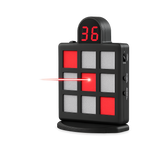
Single targets and multi-target systems train different things. A single electronic shooting target like the VPDOT 9-Grid or 7-Ring is better for precision and scoring work. The Bluetooth 4-Target System is better for speed, transitions and reaction training.
| Feature | Bluetooth 4-Target | Single Target (9-Grid) |
|---|---|---|
| Target transitions | Yes | No |
| Multi-target drills | Yes | No |
| Precision scoring | Limited | Yes |
| Wireless remote | Yes | No |
| Reaction time display | Yes | No |
| Standalone operation | Yes | Yes |
| App required | No | No |
Who Should Buy This
Competition shooters — USPSA, IDPA and 3-Gun competitors who need to train target transitions at home between matches. This system directly simulates the multi-target stages you run in competition.
Serious home trainers — Anyone who has outgrown single-target practice and wants to add real complexity to their dry fire sessions without going to the range.
Law enforcement and military — The Random Mode simulates unpredictable target activation patterns directly relevant to defensive and tactical training.
Not ideal for — Complete beginners. Start with a single target and laser cartridge first. Build fundamentals before adding multi-target complexity.
Frequently Asked Questions
Any standard laser training cartridge. The sensors detect 650nm red, 520nm green and 780nm IR laser pulses, which covers all major laser cartridge brands and wavelengths on the market.
No. The system is fully self-contained. The wireless remote handles all mode switching, scoring and session control. No phone, no app, no Bluetooth pairing with a device required.
The Bluetooth remote works up to 10 meters from the targets. For transition drills, spread them as wide as your room allows. At minimum 3 to 4 feet between each target so you are working real lateral movement.
Yes. The sensors detect laser pulses from any caliber including .223 Rem and 7.62x39. You need the appropriate laser training cartridge for your rifle caliber and enough space to work at safe dry fire distances.
Both the targets and the remote are USB-C rechargeable with long battery life for multiple training sessions per charge. Neither requires disposable batteries.
Ready to Train Transitions?
The Bluetooth 4-Target System ships from the US. Everything included. Start drilling the same day it arrives.